AI Frameworks: What They Are, Best Options, and How to Use Them

Quick Answer
AI frameworks are tools that help developers build AI applications faster. They can connect AI models to business data, software, APIs, memory, workflows, and other tools.
The right framework depends on what you are building. Some are better for AI agents. Some are better for retrieval-augmented generation, or RAG. Others suit multi-agent systems, enterprise workflows, or search.
AI Virtual helps businesses move beyond framework research. Our pre-vetted, full-time AI specialists can evaluate your current workflows, choose a practical technical approach, implement or customize the solution, train your team, and support the AI workflow over time.
What Is an AI Framework?
An AI framework is a set of reusable tools for building AI applications.
Instead of creating every part of an AI system from scratch, developers can use a framework to handle common tasks such as:
• Connecting to AI models
• Giving an AI agent access to tools
• Retrieving information from documents or databases
• Managing memory and task state
• Connecting multiple steps into a workflow
• Coordinating several AI agents
• Adding human approval steps
• Tracking what the AI did
• Testing and improving the application
Think of the framework as the structure around the AI model. The model provides the intelligence. The framework helps that intelligence work with the rest of the business system.
How Do AI Frameworks Work?
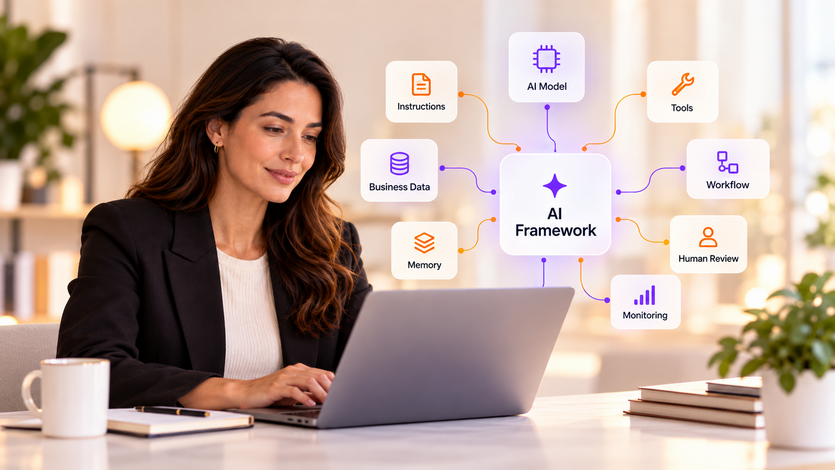
Most AI frameworks connect a few basic parts.
AI model
The framework connects to a language model or another AI model. This is the part that understands instructions and generates responses.
Instructions
The application tells the model its job, how to respond, and what rules to follow.
Tools
Tools let the AI do useful work. An agent might search a database, update a CRM, call an API, read a file, or trigger another application.
Business data
The framework can connect the AI to documents, databases, knowledge bases, or other sources. This is often used for RAG applications.
Workflow
The workflow controls what happens first, what happens next, and when the AI should ask for help or hand work to another system.
Memory and state
Memory helps the application remember useful information. State helps it keep track of where it is in a task.
Human review
Some actions should be reviewed by a person. Good frameworks can add approval points before the system takes a sensitive action.
Monitoring
Teams need to see what the AI is doing. Tracing, logs, testing, and evaluation help developers find problems and improve performance.
What Should You Look for in an AI Framework?
You do not need the framework with the longest feature list. You need the one that fits the application your business wants to run.
Look for these capabilities:
A simpler framework can be the better choice when it meets the requirements and is easier to maintain.
How AI Virtual Helps Businesses Use AI Frameworks

Choosing a framework is only one part of the project. The bigger challenge is turning it into a working process inside the business.
AI Virtual provides pre-vetted, full-time AI specialists who work as dedicated members of the client’s team. They can review the systems and workflows you already use, identify where AI can help, select a practical framework or technical approach, implement the solution, train users, and support the workflow after launch. If you want a clearer view of the role, our guide to what an AI specialist does explains how this support fits into day-to-day business operations.
A specialist can help with work such as:
• Reviewing current AI tools and business processes
• Finding repetitive or manual work that can be improved
• Comparing frameworks for the specific use case
• Building AI agents, RAG systems, automations, or integrations
• Connecting AI to existing software
• Testing the workflow with real examples
• Training the people who will use it
• Documenting the process
• Monitoring performance and improving the workflow over time
The goal is practical implementation. AI frameworks provide the technical building blocks. The AI specialist applies those building blocks to a real business process. Our guide to business process automation shows how to map, improve, and automate repetitive workflows in practice.
Best AI Frameworks for AI Apps and Agents
Several frameworks are widely used today. Each one has a different strength. If your project involves custom model integrations or AI application development, our guide to LLM development services gives additional context on how those systems are built.
Which AI Framework Should You Choose?
Start with the business problem.
- Choose LangChain + LangGraph when you need flexible agent workflows and detailed control.
- Choose LlamaIndex when your application depends heavily on internal documents, databases, or knowledge.
- Choose OpenAI Agents SDK when you want a lightweight way to build AI agents with tools and handoffs.
- Choose Microsoft Agent Framework when you need enterprise workflows, multi-agent coordination, or Microsoft ecosystem support.
- Choose CrewAI when the job is easy to divide among several specialized agents.
- Choose Haystack when search, RAG, and document processing are central to the solution.
The framework should fit the workflow. The workflow should come first.
How AI Virtual Implements AI Frameworks in 3 Steps
1. Understand the workflow
The specialist reviews the process, the people involved, the existing software, the data, and the business problem to solve.
2. Choose and implement the right approach
The specialist decides whether the use case needs an AI agent, RAG, automation, integrations, or another design. Then they select the right framework and build or configure the solution.
3. Put the workflow into daily use
The specialist helps test the solution, train users, document the process, monitor performance, and improve it over time.
This keeps framework selection connected to a real business outcome.
AI Development Frameworks vs. AI Governance Frameworks

The term "AI framework" can also mean a governance framework.
Development frameworks help teams build AI applications. Examples include LangGraph, LlamaIndex, OpenAI Agents SDK, Microsoft Agent Framework, CrewAI, and Haystack.
Governance frameworks help organizations manage AI risk, oversight, and accountability. The NIST AI Risk Management Framework is one example. ISO/IEC 42001 provides requirements for an AI management system.
A business can use both. One helps build the application. The other helps the organization manage AI use. For legal teams, our guide on whether AI will replace lawyers also explains why human judgment and oversight still matter as AI becomes part of professional workflows.
Choosing the Right AI Framework Starts With the Right Use Case
AI frameworks can make it easier to build agents, RAG systems, automations, and other AI applications, but the best choice depends on the workflow, data, and business goal. AI Virtual helps businesses evaluate those needs and turn the right framework into a practical AI workflow that teams can actually use.
FAQs About AI Frameworks
What are AI frameworks?
AI frameworks are reusable tools that help developers build and manage AI applications. They can handle models, tools, data, workflows, memory, retrieval, agents, testing, and monitoring.
What is the best AI framework for AI agents?
It depends on the application. LangGraph is useful for flexible orchestration. OpenAI Agents SDK is useful for lightweight agents. Microsoft Agent Framework fits enterprise workflows. CrewAI works well for teams of specialized agents.
Which AI framework is best for RAG?
LlamaIndex and Haystack are strong options when retrieval and business data are central to the application. LangChain can also support RAG inside a larger agent workflow.
What are the best open-source AI frameworks?
Popular open-source options include LangChain and LangGraph, LlamaIndex, OpenAI Agents SDK, Microsoft Agent Framework, CrewAI, and Haystack.
Do I need an AI framework?
A simple AI feature may only need a direct model API call. Frameworks become more useful when the application needs tools, business data, memory, multiple steps, agents, human review, or monitoring.
Can AI Virtual help choose and implement an AI framework?
Yes. AI Virtual specialists can evaluate your workflow and current systems, recommend a practical technical approach, implement or customize the solution, train your team, and support the AI workflow over time.
Ready to Close the Gaps You Just Found?
Get matched with an AI specialist who identifies opportunities and implements solutions that improve your operations.