
LLM Development Services: What Businesses Should Build, Integrate, and Operationalize

Quick answer
LLM development services help a business design, build, integrate, test, deploy, and maintain workflows powered by large language models. The strongest projects start with a defined business process, then select the smallest technical pattern that can solve it. Common patterns include retrieval-augmented generation, structured extraction, AI agents, workflow automation, tool calling, and model-backed knowledge assistants.
LLM development services help businesses design, build, integrate, test, deploy, and maintain workflows powered by large language models. The strongest projects begin with a defined business process and a measurable outcome. From there, the team can choose the smallest technical pattern that can perform the work reliably.
A useful LLM application is usually part of a larger operating system. It may retrieve approved knowledge, interpret unstructured information, generate a draft, call a business system, classify a request, or support a human decision. The value comes from how those components work together inside the workflow.
For example, an internal policy assistant can combine an approved document repository, retrieval, an LLM, user permissions, citations, feedback capture, and escalation. A sales intake flow can read an inquiry, extract structured fields, check a CRM, request missing information, create a record, and route exceptions. In both cases, the model handles language and interpretation while software rules control predictable actions.
What Are LLM Development Services?
LLM development services cover the technical and operational work required to apply large language models to real business processes. Depending on the use case, the work may include requirements discovery, model evaluation, prompt and context design, retrieval, agent development, API integration, data preparation, evaluation, security controls, deployment, monitoring, and user adoption.
Governance belongs in the implementation scope when the use case introduces meaningful AI risk. The NIST Generative AI Profile provides a cross-sector reference for identifying and managing generative AI risks across the lifecycle. Teams should define ownership, context of use, evaluation criteria, human review, and change management before deployment.
What LLM Workflows Should Businesses Build First?
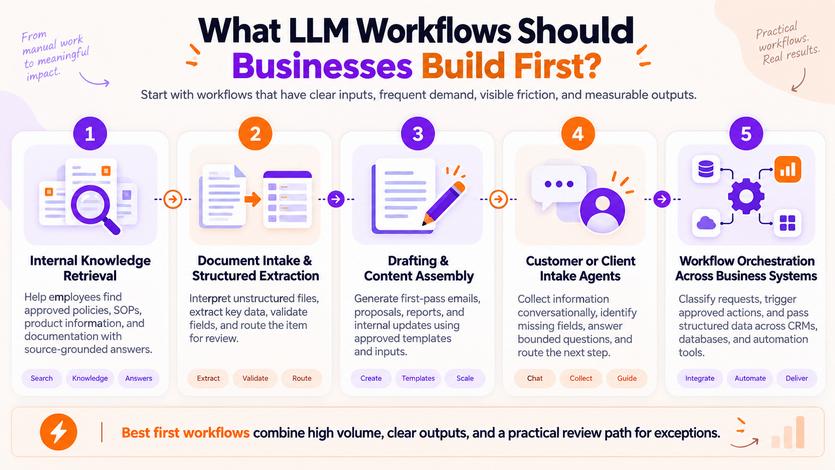
The best first workflow has clear inputs, frequent demand, visible process friction, and a measurable output. First, look for repetitive knowledge work that employees already perform manually. Next, confirm the process is consistent enough to define success. Finally, choose a workflow where a human can review exceptions during early rollout.
1. Internal Knowledge Retrieval
A retrieval-based assistant can help employees search policies, SOPs, product information, project documentation, or other approved knowledge. The application retrieves relevant sources and provides them as context to the model. This lets users validate answers against source material while the organization updates its knowledge independently of the model.
2. Document Intake and Structured Extraction
LLMs can interpret unstructured documents and map information into structured fields. A workflow can identify document type, extract parties and dates, summarize key sections, and flag missing information. Deterministic rules can then validate required fields and route the item. This reduces manual data entry while keeping source documents available for verification.
3. Drafting and Content Assembly
A controlled drafting workflow can combine approved templates, source data, brand or policy guidance, and defined review steps. The model may create a first-pass email, proposal section, report narrative, status update, or internal memo. The application should expose the source inputs and identify which outputs require human approval.
4. Customer or Client Intake Agents
An intake agent can collect information conversationally, identify missing fields, answer bounded process questions, create a record, and route the next step. The design should define scope boundaries and escalation paths because users may ask questions that exceed the agent’s authority. Information collection, recommendations, and higher-consequence decisions should have clearly defined ownership.
5. Workflow Orchestration Across Business Systems
LLMs become more useful when they can interpret context and trigger approved tools. For example, a model can classify an inbound request, choose a predefined workflow, and pass structured data to a CRM or automation platform. Software rules can govern permissions, transaction boundaries, record updates, retries, and escalation.
For more examples of AI agents, workflow automation, integrations, and knowledge systems, review AI Virtual’s AI capabilities.
RAG, Agents, Fine-Tuning, or a Custom Model: Which Pattern Fits?
Leaders can make better build decisions by separating the main LLM patterns. Retrieval-augmented generation, or RAG, connects a model to external knowledge at request time. Agentic systems allow a model to select actions or tools within defined boundaries. Fine-tuning modifies model behavior using additional training examples. Training a foundation model from scratch is a substantially larger research and infrastructure program.
The default decision rule is simplicity. If structured prompting, retrieval, and deterministic validation can solve the workflow, that architecture is usually easier to test and operate than a highly autonomous multi-agent design. Agent architectures become more appropriate when the workflow genuinely requires planning, tool use, state, and iterative actions.
When Should a Company Build a Custom LLM Solution?
A custom LLM application makes sense when an existing product cannot meet the workflow, integration, data boundary, user experience, or control requirements. For example, a business may need one intake flow that connects its website, CRM, document system, and internal approval process. A proprietary knowledge assistant may need permission-aware retrieval across several internal repositories.
- The workflow is strategically important. It affects revenue, customer experience, operational capacity, compliance, or a high-volume internal function.
- Your systems must work together. The solution needs APIs, business rules, data mapping, or state across multiple platforms.
- You need tighter control over context and behavior. The application must use defined knowledge sources, templates, schemas, review steps, or tool permissions.
- The use case repeats at meaningful volume. Recurring work can justify engineering and ongoing ownership.
- You can define success. The team can specify quality, completion, latency, accuracy, escalation, adoption, or business metrics.
An existing enterprise product may still be the best answer when it already supports the workflow well. Evaluate build, buy, configure, and integrate options before committing to custom development. The decision should optimize for operational fit, maintainability, and business value.
If you are comparing potential use cases across departments, AI Virtual’s Solutions page provides examples of where AI can support business operations.
How Do Businesses Integrate LLMs Into Workflows?
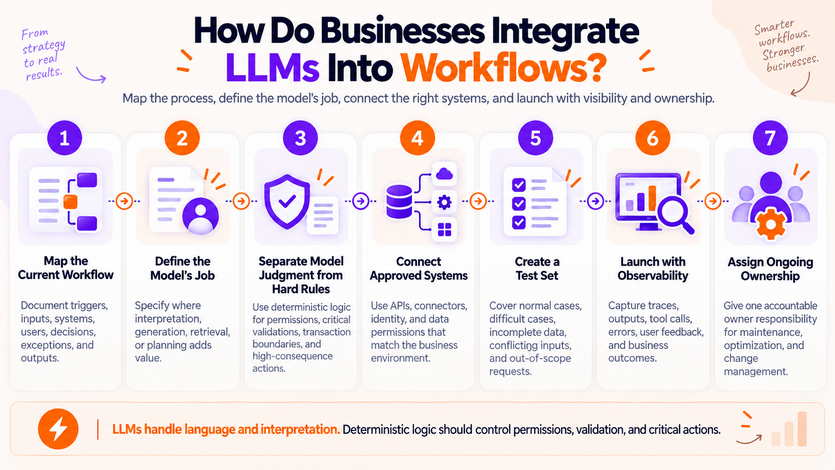
Integration starts by mapping the system of record and the event that triggers work. For example, a new web form may create an intake event. The workflow can pass the data to an LLM for classification, validate the structured response, create a CRM record, request missing documents, and assign a human owner. Because each step has a defined contract, the system can log failures and recover predictably.
- Map the current workflow. Document triggers, inputs, systems, users, decisions, exceptions, and outputs before changing technology.
- Define the model’s job. Specify exactly where interpretation, generation, retrieval, or planning adds value.
- Separate AI decisions from hard rules. Use deterministic logic for permissions, critical validations, transaction boundaries, and high-consequence actions.
- Connect approved systems. Use APIs, connectors, identity, and data permissions that match the organization’s existing environment.
- Create a test set. Use real-world examples that cover normal cases, difficult cases, incomplete data, conflicting inputs, and out-of-scope requests.
- Launch with observability. Capture traces, outputs, tool calls, errors, user feedback, and business outcomes so the team can improve the workflow.
- Assign ongoing ownership. Models, APIs, data, and business processes change, so someone must own maintenance and optimization after launch.
The NIST AI Risk Management Framework is a useful reference for organizing risk management across the design, development, deployment, and use of AI systems. In parallel, each business should review provider-specific data use, retention, access controls, regional settings, and its own security and privacy requirements before production deployment.
What Should LLM Development Services Include?
A credible scope should cover application development and production operations. The provider or specialist should define requirements and acceptance criteria, build the smallest viable architecture, test it against representative cases, prepare deployment controls, and document how the system will be owned after launch.
The scope should also define what happens after the first release. Production LLM applications can change when source documents shift, users introduce new patterns, an API changes, or a model update alters outputs. Plan for regression testing, version control, prompt and configuration management, feedback review, and periodic re-evaluation.
How to Measure an LLM Application
A single accuracy score rarely captures business value. Instead, the evaluation should combine model quality with workflow outcomes. For example, a document-extraction system may need field-level correctness, successful validation, review time, and exception rate. Similarly, a knowledge assistant may need source-grounded answer quality, citation usefulness, time to answer, and user adoption.
- Task quality. Does the output meet the use case's defined requirements?
- Grounding and traceability. Can users verify claims against trusted sources when the workflow requires it?
- Completion rate. How often does the workflow reach the intended end state?
- Exception rate. How frequently does the process require manual intervention or escalation?
- Latency. Does the response time fit the operating context?
- Cost per completed workflow. What is the total cost of model calls, tools, infrastructure, and review for a successful outcome?
- User adoption. Do employees actually use the workflow consistently?
- Business impact. Does the solution improve response time, throughput, quality, capacity, or another agreed KPI?
Which AI Roles Own LLM Development and Operations?
LLM projects often cross several role boundaries. An AI Agent Developer can build application logic, retrieval, agents, and integrations. An AI Implementation Specialist can connect the solution to the operating workflow, coordinate testing, train users, and drive adoption. An AI Systems Administrator can manage approved platforms, access, integrations, and operational monitoring. An AI Compliance & Governance Manager can support review processes, documentation, and governance controls.
Development is one stage of the lifecycle. The workflow may operate for years, so an accountable owner should keep it aligned to business changes, vendor updates, user feedback, performance targets, and governance requirements.
How AI Virtual Fits the LLM Development Decision

AI Virtual places full-time, dedicated AI specialists inside the client’s team. This model suits businesses that need ongoing ownership across implementation, optimization, and governance. Specialists go through a structured screening process that covers technical depth, communication, and proven deployment experience.
For leaders evaluating LLM development services, a practical next step is to define one workflow in operational terms: the trigger, users, systems, data sources, required actions, human decisions, failure points, and desired outcome. Then map the work to the specialist role that should own the build, rollout, or ongoing operation.
You can review how AI Virtual works to see how specialist matching and engagement are structured.
Frequently Asked Questions
What are LLM development services?
LLM development services design, build, integrate, test, deploy, and maintain business applications powered by large language models. Typical work includes RAG, AI agents, structured extraction, tool calling, workflow automation, evaluation, integrations, and production monitoring.
What LLM workflows should businesses build first?
Start with frequent workflows that have clear inputs, measurable friction, defined outputs, and a manageable review process. Common candidates include internal knowledge retrieval, document intake, structured extraction, drafting support, intake agents, and cross-system workflow orchestration.
When should a company build a custom LLM solution?
A custom application makes sense when the business needs unique integrations, proprietary knowledge, workflow-specific controls, a tailored user experience, or behavior that off-the-shelf products do not support well.
What is the difference between RAG and fine-tuning?
RAG retrieves relevant external information at request time and gives it to the model as context. Fine-tuning modifies model behavior using additional training examples. Businesses often use RAG for current or proprietary knowledge and consider fine-tuning when they need more consistent behavior than prompting alone provides.
How do businesses integrate LLMs into workflows?
Map the existing process, define the model’s job, connect approved systems through APIs or connectors, use deterministic rules for critical actions, test representative cases, add human review where required, and monitor the workflow after launch.
What should LLM development services include?
A complete scope should include requirements, architecture, data and access design, model selection, application development, evaluation, human review, integration, deployment, monitoring, documentation, and an ongoing ownership plan.
Next step for businesses
If you already have a workflow that could benefit from retrieval, agents, document intelligence, or cross-system automation, AI Virtual can help map the build and implementation work to a dedicated AI specialist.
Ready to Close the Gaps You Just Found?
Get matched with an AI specialist who identifies opportunities and implements solutions that improve your operations.