
What Is an AI Specialist? Roles, Responsibilities, and When Businesses Need One
Quick answer
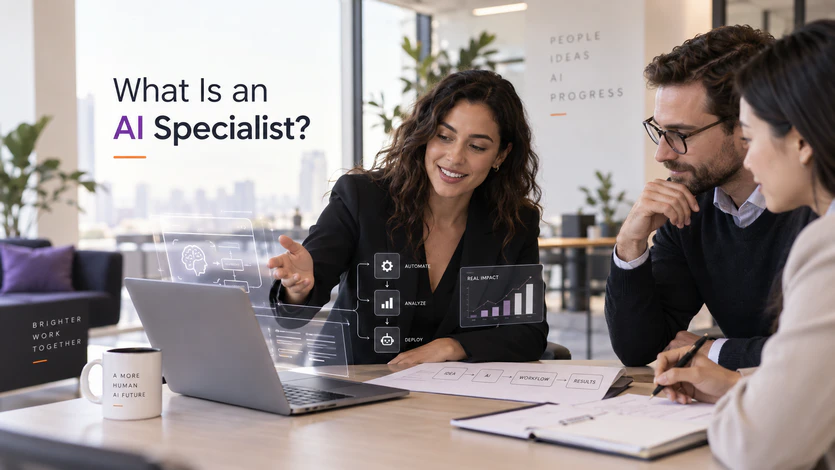
An AI specialist is a professional who helps a business turn AI capabilities into working systems, workflows, controls, or decisions. Responsibilities depend on the problem. One specialist may build AI agents, another may lead implementation and adoption, another may administer platforms, and another may manage governance. Therefore, businesses should define the operational gap before choosing the role.
The term “AI specialist” can sound like one broad job title. In reality, it describes a family of roles that apply artificial intelligence to different parts of the business. For example, a company that needs a customer-intake agent has a different problem from a company that already bought AI tools and now needs to get employees using them consistently. Similarly, a company with uncontrolled AI usage needs governance ownership rather than another automation build.
Because AI now touches operations, data, security, customer experience, knowledge management, and software, a generic role description often creates confusion. Therefore, leaders should ask a more useful question: what should this person own every day? Once the ownership is clear, the right AI specialist becomes easier to define, evaluate, and integrate into the team.
What Does an AI Specialist Do?
An AI specialist converts a business objective into practical AI work. First, the specialist needs to understand the workflow, systems, data, users, and constraints. Next, they identify the right combination of models, automation, integrations, human review, and governance. Then they build, configure, test, launch, or manage the solution based on their role.
In practice, an AI specialist may spend part of the week mapping a workflow with operations, part of the week configuring an integration, and part of the week testing outputs with users. However, the work should stay anchored to a measurable operating problem. Useful ownership might include reducing manual intake handoffs, improving CRM completeness, deploying an internal knowledge assistant, controlling access to AI tools, or setting up a repeatable review process for new AI use cases.
The Six AI Specialist Roles AI Virtual Uses

AI Virtual uses defined role architecture so a business can align the specialist to the work rather than hire a vague “AI person.” Current client-facing roles include AI Director, AI Agent Developer, AI Implementation Specialist, AI Systems Administrator, AI Compliance & Governance Manager, and AI Forward Deployed Engineer. In addition, AI Virtual’s current go-to-market focus emphasizes the AI Agent Developer, AI Implementation Specialist, and AI Compliance & Governance Manager because they map directly to build, adoption, and governance needs.
AI Director: Prioritizes Where AI Should Create Value
An AI Director operates at the strategic layer. Specifically, this role evaluates where AI can support business goals, which initiatives deserve priority, what to build or buy, and how leaders should measure the AI portfolio. As a result, the AI Director can help prevent scattered experimentation from consuming budget and management attention.
AI Agent Developer: Builds Agents, Automations, and Intelligent Workflows
An AI Agent Developer turns a defined requirement into a functioning technical solution. For example, the developer may build an agent that collects intake information, calls an internal API, updates a CRM, retrieves approved knowledge, and routes exceptions to a person. Therefore, this role needs hands-on skill with models, APIs, agent frameworks, data, integrations, testing, and production reliability.
AI Implementation Specialist: Moves Approved AI Into Daily Operations
An AI Implementation Specialist focuses on the gap between an available AI solution and a working business process. The role can map the current workflow, configure the solution, coordinate integrations, prepare testing, train users, support go-live, and improve the process after launch. Consequently, this role is especially relevant when leadership has already selected a tool or initiative, but adoption remains inconsistent.
AI Systems Administrator: Keeps AI Platforms Operational
An AI Systems Administrator manages the day-to-day environment around approved AI platforms. Responsibilities can include access, role permissions, integrations, configuration, usage monitoring, updates, support, and operational documentation. Meanwhile, the administrator provides continuity after implementation so production AI does not become an ownerless set of accounts and connectors.
AI Compliance & Governance Manager: Operationalizes Responsible AI
An AI Compliance & Governance Manager translates policy, risk, privacy, security, and regulatory expectations into repeatable operating processes. For instance, the role may coordinate AI impact assessments, maintain a register of AI use cases, support vendor reviews, track remediation, and organize human-oversight requirements. Therefore, this role becomes important as AI usage expands beyond isolated experiments.
AI Forward Deployed Engineer: Solves Complex Problems With the Client
An AI Forward Deployed Engineer works where client requirements, operational constraints, data, and technical systems meet. The engineer can investigate a difficult process, prototype a solution, integrate systems, gather real-world feedback, and iterate quickly. As a result, the role fits ambiguous problems that require both client-facing discovery and strong technical execution.
What Skills Should an AI Specialist Have?
The best skill set depends on the role, yet strong AI specialists share a common operating foundation. First, they understand what current AI systems can and cannot do. Second, they can translate a business problem into explicit requirements. Third, they can communicate tradeoffs clearly to non-technical stakeholders. Finally, they can test their work against real process conditions rather than stop at a demo.
- Workflow analysis. The specialist can map triggers, inputs, decisions, systems, handoffs, exceptions, and outputs.
- AI model literacy. They understand prompting, context, retrieval, tool use, evaluation, model selection, and common failure modes.
- Integration skills. Depending on the role, they can work with APIs, webhooks, CRM systems, databases, automation platforms, and identity controls.
- Testing and evaluation. They define representative test cases, expected behavior, edge cases, escalation rules, and acceptance criteria.
- Data and security awareness. They understand access boundaries, sensitive data handling, logging, retention, and the need to follow approved organizational controls.
- Change and adoption skills. Implementation-focused specialists can train users, create documentation, collect feedback, and turn a pilot into a repeatable workflow.
- Business communication. They explain technical constraints in terms of risk, cost, operational impact, and next decisions.
- Ongoing optimization. They monitor usage and performance, diagnose failures, and improve workflows as tools and business requirements change.
In addition, credentials can support evidence of knowledge when they match the role. A governance professional may benefit from an AI governance credential or formal framework training, while a technical specialist may benefit from cloud or AI platform certifications. However, a certificate alone cannot prove that someone can deliver a production workflow. Therefore, practical screening should include evidence of deployed work, problem-solving, communication, and role-specific technical depth.
When Should a Business Hire an AI Specialist?
A company usually needs dedicated AI ownership when the problem persists after leadership buys access to tools. For example, employees may have ChatGPT or another AI product, yet nobody owns workflow design, data rules, training, integration, or measurement. Similarly, an automation may work in a pilot but fail to become part of the operating process because exceptions, handoffs, and responsibilities remain unclear.
Another signal is recurring management involvement. If a COO, managing partner, or department head must personally chase integrations, troubleshoot prompts, review vendor settings, and remind staff how to use the new process, the organization has an ownership gap. Accordingly, a dedicated specialist can convert executive attention into a managed operating function.
AI Specialist vs. Consultant vs. General IT Support
These delivery models overlap, yet they solve different continuity problems. A consultant can provide analysis, a project, or specialized advice. General IT support can manage infrastructure, accounts, and established systems. A dedicated AI specialist can own a defined AI capability inside the business over time, especially when workflows require repeated iteration across operations and technology
Therefore, the choice should follow the operating need. A one-time architecture review may justify consulting. A recurring pipeline of AI workflows may justify a dedicated specialist. A company can also use both models at different stages, such as an external expert for a narrow assessment and a full-time specialist for daily implementation ownership.
How to Evaluate an AI Specialist Before You Hire
The interview should test how the person thinks, not just which tools they have used. Because platforms change quickly, durable capability comes from workflow reasoning, technical fundamentals, testing discipline, and communication. Therefore, ask candidates to work through a real business process and explain their assumptions, risks, architecture, evaluation plan, and human handoffs.
- Start with a real workflow. Give the candidate a process such as intake, document routing, follow-up, or internal knowledge retrieval and ask them to map it.
- Ask for production evidence. Discuss what they have deployed, who used it, how they tested it, what failed, and what changed after launch.
- Probe model and tool selection. A strong candidate should explain selection criteria rather than default to one vendor for every task.
- Test failure handling. Ask what happens when data is missing, an API fails, the model returns a weak answer, or a user goes outside the intended workflow.
- Review security and governance thinking. Ask how they would handle access, sensitive data, logs, approvals, human review, and vendor changes.
- Evaluate communication. Have the candidate explain the solution to an executive, an operations manager, and a technical stakeholder in clear language.
- Define the first 30 to 60 days. A strong specialist should be able to propose a sequence for discovery, prioritization, implementation, testing, adoption, and measurement.
Do Companies Need a Dedicated AI Specialist?

A dedicated role becomes more valuable as AI moves from occasional productivity use into business-critical workflows. Once AI connects to customer intake, documents, CRM records, internal knowledge, approvals, or operational decisions, the company needs someone who can keep the system aligned with the process. Otherwise, ownership often fragments across operations, IT, vendors, and individual power users.
AI systems also change quickly. Models improve, vendor features evolve, APIs change, and business processes shift. Therefore, the person who owns the implementation needs to monitor both the technology and the workflow. This ongoing loop of testing, feedback, and optimization separates durable implementation from a one-time setup.
How AI Virtual Approaches AI Specialist Placement

AI Virtual’s model centers on full-time, dedicated AI specialists who join the client’s team and focus on the client’s AI needs. The company states that its specialist pool goes through a structured screening process covering technical depth, communication, and proven deployment experience. In addition, AI Virtual states that businesses can be matched with a specialist in three business days and that the engagement uses one transparent monthly rate.
More importantly, the role architecture gives buyers a clearer way to scope the need. Instead of starting with a generic request for “someone good at AI,” the business can start with the problem: build an agent, implement an approved solution, manage AI systems, create governance ownership, prioritize the roadmap, or solve a complex technical workflow. As a result, the specialist can enter with a defined mandate and measurable operating outcomes.
If your team already has a concrete AI implementation problem, the next step is to document the workflow, current systems, users, desired outcome, and biggest failure point. Then use that operating brief to determine which AI specialist role should own the work. That approach improves hiring quality because the business evaluates the candidate against the job that actually needs to get done.
Frequently Asked Questions
What does an AI specialist do?
An AI specialist turns business needs into working AI systems, workflows, controls, or decisions. Responsibilities can include workflow analysis, agent development, integrations, implementation, testing, user adoption, platform administration, governance, and ongoing optimization depending on the role.
When should a business hire an AI specialist?
Consider dedicated ownership when AI tools or pilots exist, but implementation is stalled, a recurring process needs automation, employees need adoption support, AI platforms require administration, or governance responsibilities are unclear.
What skills should an AI specialist have?
Core skills include workflow analysis, model literacy, testing, data and security awareness, communication, and role-specific technical depth. Build-focused roles need stronger software and integration skills, while governance or implementation roles need deeper process, control, and change-management capabilities.
Is an AI specialist the same as an AI developer?
An AI developer is one type of AI specialist. Developers primarily build technical solutions. Other AI specialists may lead implementation, administer platforms, manage governance, prioritize strategy, or solve client-specific technical problems.
Do companies need a dedicated AI specialist?
Companies benefit from dedicated ownership when AI becomes part of recurring operations. A dedicated specialist can maintain continuity across implementation, testing, adoption, monitoring, and improvement as business requirements and AI tools change.
How does AI Virtual screen AI specialists?
AI Virtual says its vetted specialist pool goes through a structured screening process covering technical depth, communication, and proven deployment experience before specialists appear in its network.
Next step for businesses
If your business has a defined AI workflow, implementation, systems, or governance gap, AI Virtual can help align that need to a dedicated specialist role.
Ready to Close the Gaps You Just Found?
Get matched with an AI specialist who identifies opportunities and implements solutions that improve your operations.