

No articles in this category yet
We're working on new guides for this topic. Check back soon, or browse all posts to see everything we've published.
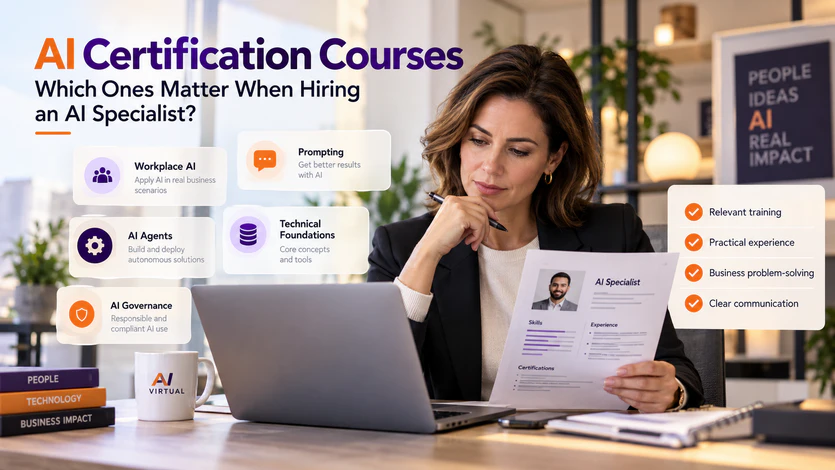
• AI certification courses cover different skills, including everyday AI use, task automation, technical tools, and responsible oversight.
• A certificate shows what someone has studied or been assessed on. Ask how that knowledge translates into actual business work.
• CompTIA and Google cover workplace AI skills, Microsoft offers technical foundations, and IAPP AIGP and ISO/IEC 42001 training support AI governance knowledge.
• Compare each course with the specialist's responsibilities, then review practical examples, communication, and ongoing support.
When you compare AI certification courses, you may be trying to answer a bigger business question: who has the skills to improve the way your company works? Perhaps customer follow-ups take too long, employees repeat the same tasks, or new AI tools haven't become part of daily operations. The right specialist needs qualifications that relate directly to those challenges.
A recognizable certificate can be a useful starting point. However, you also need to know what that person has done in a real business. Can they explain your processes clearly? Have they delivered similar work? Can they train employees and support improvements after launch? These questions help you judge how much value the training brings to your situation.
This guide compares AI certification programs from established providers, explains the skills they cover, and helps you decide which qualifications are relevant when evaluating an AI specialist. The focus is on understanding the courses first, then connecting them to the business results you want.

Start by identifying the work your specialist will handle. A course focused on workplace AI is different from one covering automated systems or company-wide AI rules.
Here are common business challenges and the types of specialists who may address them.
• Your staff repeat customer-facing or administrative tasks: An AI Agent Developer can build AI agents that help handle defined tasks, such as collecting inquiries, updating records, or preparing follow-ups.
• You bought AI tools, but staff needs help using them: An AI Implementation Specialist can assess current workflows, configure tools, coordinate testing, and train employees.
• You need priorities and an AI plan across departments: An AI Director can identify opportunities, decide what to tackle first, and connect the work to business goals.
• You need someone to maintain AI tools and manage employee access: An AI Systems Administrator can support system operation, permissions, and troubleshooting.
• You handle sensitive information and need clear AI rules: An AI Compliance & Governance Manager can help establish appropriate policies, reviews, and oversight.
• Your business needs a more complex custom AI solution: An AI Forward Deployed Engineer can work with your teams to shape and deliver a solution for a specific operational need.
You might need one role now, and others as your use of AI expands. The important step is to assign a clear owner to the outcome you expect, then assess that specialist's qualifications against it.
AI certification courses can show what a specialist has learned, whether they completed an assessment, and which subjects they know. They help you build a shortlist. To make a hiring decision, connect that training to hands-on experience with business processes, employee training, technical tools, or risk management.
• Introductory AI course: Indicates knowledge of basic AI concepts and workplace uses. Ask the specialist to explain how AI would help one of your daily processes.
• Skills-based or professional certificate: May include assessments or projects. Ask to see a relevant example and hear what the person learned from testing it.
• Technical certification: Indicates knowledge of a technology platform. Ask how the specialist has used that knowledge to connect, operate, or improve business tools.
• Governance training: Indicates familiarity with AI policies and risks. Ask for a sample policy or a clear explanation of how they would handle sensitive information.
The best course is the one relevant to the work you need done. A specialist who builds customer follow-up automations may need different training from someone responsible for privacy and AI policies. The next section compares recognized programs by the skills they teach and the business situations where those skills can be helpful.
The following AI certification courses and training pathways support different areas of AI work. Review the course descriptions, then use the suggested questions to assess how a specialist would apply that learning in your organization.
This course introduces fundamental AI concepts, workplace applications, and responsible use. It can be useful background for a specialist who will help your team understand where AI makes sense.
What to ask: “If my team spends too much time sorting customer requests, how would you decide whether AI could help?” Look for a sensible process and an explanation you can follow.
This training focuses on giving AI clear instructions, checking results, and using AI responsibly. It is relevant when a specialist will help staff use AI for summaries, drafting, organizing information, or repeatable tasks.
What to ask: “Can you show us a process where employees use AI consistently and know when to review or correct the answer?”
This course covers AI agents and how they fit into workflows. An AI agent can carry out connected steps, such as collecting an inquiry, updating a record, and preparing a follow-up. For specialists building agents, introductory training should include examples of working systems.
What to ask: “Show me an automation you built. What did it do, where did it connect to our type of software, and how did it handle a problem or human handoff?”
Google AI Essentials covers workplace AI fundamentals, productivity, clear instructions, and responsible use. It supports the basic AI knowledge specialists need to communicate with employees new to AI.
What to ask: “How would you help my team start using AI for a routine task, and how would you check whether it was useful?”
The Google AI Professional Certificate includes practical activities across workplace situations. The strongest hiring signal is whether the specialist can show what they produced and explain the decisions behind it.
What to ask: “Walk me through a project. What problem were you solving, what did you change after testing, and how could the approach work in our business?”
Microsoft Azure AI Fundamentals covers foundational AI concepts and Microsoft AI services. It may be relevant when your business relies on Microsoft systems or wants AI to work with tools in that environment.
What to ask: “Which Microsoft systems have you worked with, and can you explain how you would introduce an AI capability into a workflow our team already uses?”
The IAPP Artificial Intelligence Governance Professional credential focuses on responsible AI use, governance, and risk. It is especially relevant if your specialist will oversee AI use, establish policies, or coordinate reviews involving sensitive data.
What to ask: “What rules would you recommend if staff wanted to enter customer or client information into an AI tool? Who should approve the tool and review any concerns?”
ISO/IEC 42001 is a standard for AI management systems. Training based on it can help a specialist define responsibilities, set policies, review risks, and improve practices as AI use expands.
What to ask: “If three departments are using different AI tools, how would you create clear company-wide rules and a process for reviewing them?”
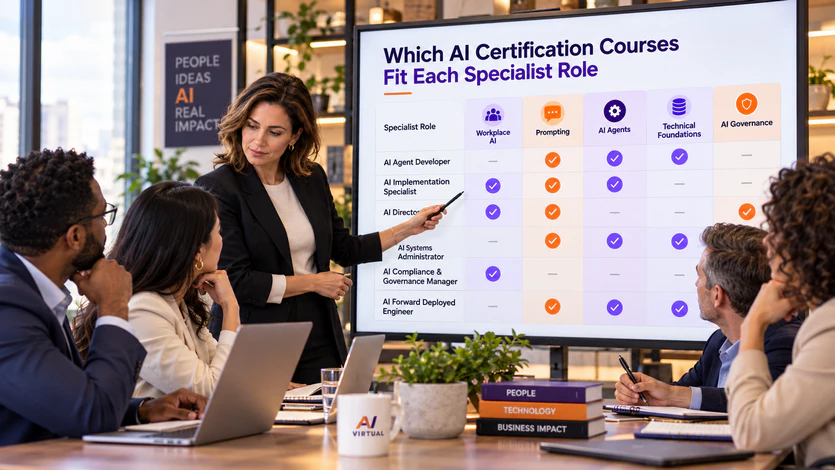
Once you understand the courses, compare them with the responsibilities you want your specialist to take on. These examples show which training is relevant, along with the practical work you should ask to see.
Business objective: Reduce repetitive work by building AI agents or automation for defined processes. Relevant evidence may include AI agent training, technical skills, and examples of tools that work with business systems. Ask to see a live or recorded demonstration, plus an explanation of testing and what happens when staff need to step in.
Business objective: Turn existing or newly selected AI tools into processes your employees can use. Practical AI courses and platform training may be helpful. Prioritize evidence of workflow planning, setup, employee training, testing, and adoption support. Ask how the specialist would handle staff questions during a rollout.
Business objective: Establish responsible AI use across your organization. IAPP AIGP, ISO/IEC 42001 training, and relevant privacy or risk education may apply. Ask for examples of policies, risk reviews, approved-tool processes, and communication with business leaders.
For an AI Director, review business-focused AI learning alongside examples of priorities, decision-making, and measured outcomes. For an AI Systems Administrator, review technical and security experience, system reliability, and access management. For an AI Forward Deployed Engineer, ask for evidence of custom solutions delivered in collaboration with business teams.

Use the same questions for every specialist you evaluate. They help you check both the relevance of their AI training and their ability to work effectively with your team.
1. Have you worked on a problem like ours? Ask for a relevant example and the specialist's exact contribution.
2. What would you do first? Look for an assessment of existing processes, systems, risks, and people involved.
3. How will our employees be involved? Ask about testing, training, feedback, and human review.
4. How will we know the work is helping? Discuss practical measures, such as response times, manual steps, usage, or accuracy.
5. What happens after launch? Clarify who will monitor results, resolve issues, and improve the process.
6. Which certifications support this work? Check the provider, the topic covered, and how the knowledge was assessed.
Pay attention to how the specialist answers. Clear, specific explanations make it easier for you to decide whether they understand your operations and can collaborate with your employees.
Once you know which business process needs attention, the next step is finding a person with the right capabilities. AI Virtual matches businesses with pre-vetted, full-time AI specialists who work as dedicated members of the client's team. Each engagement comes at a flat monthly rate, with the role aligned to the work the business needs to accomplish.
Your specialist's responsibilities may include building AI agents, integrating AI into daily workflows, supporting employee adoption, or overseeing AI use. Certifications are one useful consideration alongside the practical skills and experience required for those responsibilities. Explore AI Virtual's capabilities and learn how its specialist-matching process works.

AI certification courses can help you identify a specialist's knowledge, but the final decision should reflect your business's needs. If you're ready to improve a workflow, help your team adopt AI, or establish clearer oversight, AI Virtual can help you discuss the role and experience that fit those objectives.
Start with the role you need. Google and CompTIA courses can support workplace AI knowledge. Microsoft training may be relevant to technical work. IAPP AIGP and ISO/IEC 42001 training apply to AI governance. Ask for work examples linked to your actual business goals.
Some courses include assessments or projects that can demonstrate knowledge. To evaluate real-world capability, ask for work samples, a description of the specialist's contribution, and evidence that a similar process worked in a business setting.
Look for hands-on experience with business workflows, software setup, testing, staff training, and rollout support. Relevant AI courses can strengthen the profile, but examples of implementation work matter most.
You can evaluate much of the role through business questions. Ask the specialist to explain the process they would improve, who on your team needs to participate, what they would deliver, and how problems would be addressed.
AI governance training, such as IAPP AIGP or courses related to ISO/IEC 42001, may be useful. Review the specialist's experience with access rules, privacy, tool approvals, documentation, and human oversight.
Give both the same business scenario. Compare the relevance of their training, work samples, understanding of your systems, communication, and plan for support after launch. The better fit is the person who can clearly take responsibility for the work you need done.
Next step for businesses
If you want to put AI to work across your team, AI Virtual can match you with a pre-vetted, dedicated AI specialist whose responsibilities align with your goals. Discuss the workflows you want to improve and the experience your specialist should bring.
Get matched with an AI specialist who identifies opportunities and implements solutions that improve your operations.
We're working on new guides for this topic. Check back soon, or browse all posts to see everything we've published.