


No articles in this category yet
We're working on new guides for this topic. Check back soon, or browse all posts to see everything we've published.

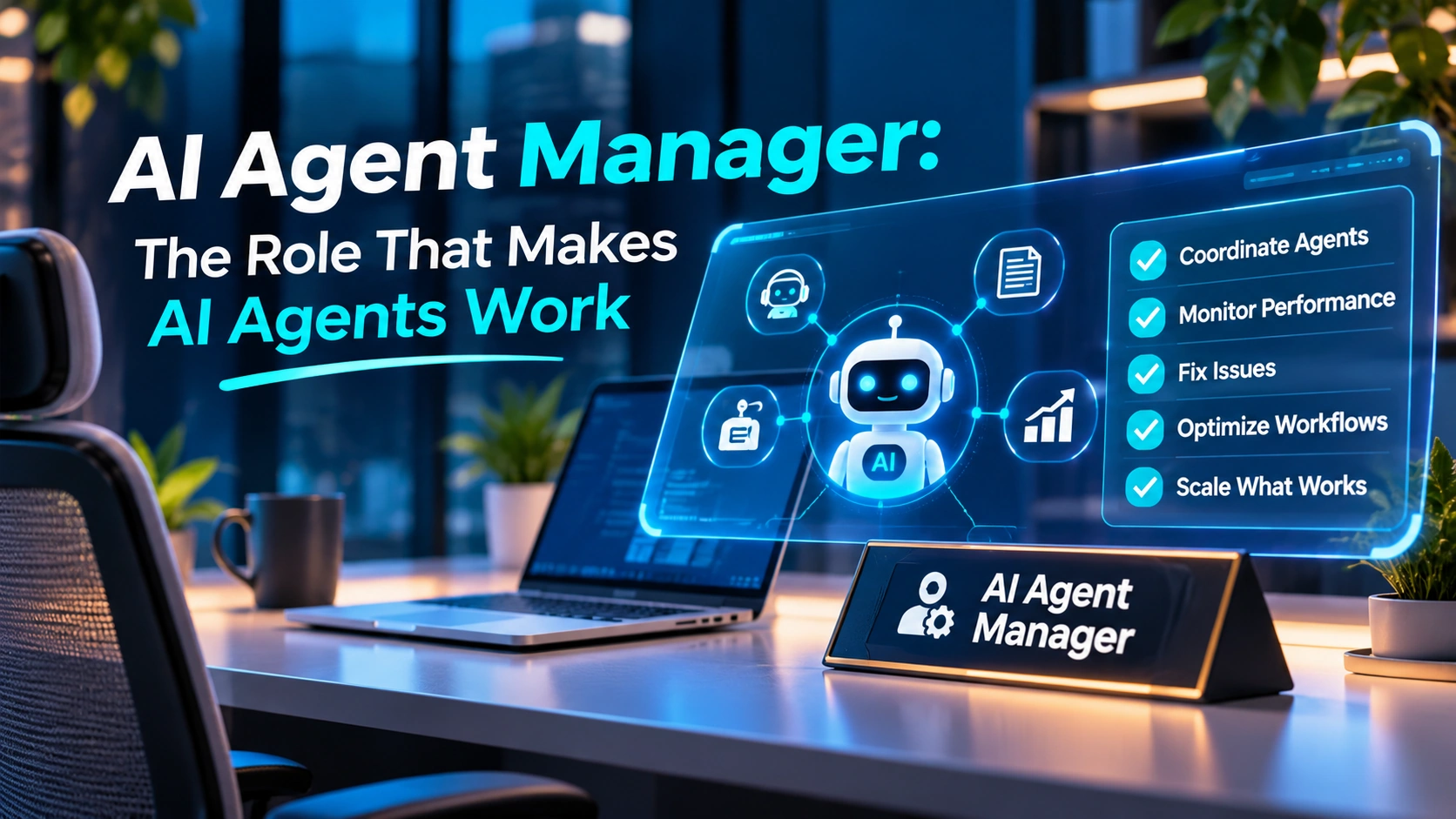
AI agents can now answer customers, qualify leads, update records and chase invoices with little human input. That is exactly why they need a manager. An agent that runs on its own can also make mistakes on its own, at scale.
This guide explains what an AI agent manager does, the skills and metrics that matter, and how a small or mid-sized business can fill the role without hiring an executive.
An AI agent manager is the person accountable for how AI agents perform inside a business. They decide what each agent does, what it is allowed to touch, how its work is checked and when a human must step in.
In "To Thrive in the AI Era, Companies Need Agent Managers" (Harvard Business Review, February 2026), Suraj Srinivasan of Harvard Business School and Vivienne Wei of Salesforce describe agent managers as the leaders who orchestrate how agents learn, collaborate, perform and work safely alongside humans.
Their core comparison: just as software created the product manager, AI agents are creating the agent manager.
Microsoft's 2025 Work Trend Index made a similar point from the employee side. It predicted that workers will increasingly build, delegate to and manage agents, a shift it called becoming an "agent boss."
Three trends turned agent management from a nice idea into a real job.
1. Agents are moving into everyday software. Gartner predicted that 40% of enterprise applications would include task-specific AI agents by the end of 2026, up from less than 5% in 2025.
2. Many agent projects fail without ownership. Gartner also predicts that over 40% of agentic AI projects will be canceled by the end of 2027 because of rising costs, unclear value or weak risk controls.
3. Agents act, not just answer. A chatbot that gives a bad answer is a problem. An agent that sends the wrong email to 500 clients, or changes CRM records, is a bigger one.
In short, the technology is ready faster than most organizations are. The agent manager closes that gap.
The role breaks into five areas of responsibility. Each one keeps agents useful, safe and accountable.
The agent manager decides which tasks go to agents and which stay with people. They also define where the handoff happens. For example, an agent drafts intake summaries, and a paralegal approves them before they reach the attorney.
Guardrails define what an agent may access, change and say. They cover permissions, approval steps, tone and escalation rules. For example, a billing agent can send payment reminders but cannot change invoice amounts.
The agent manager tracks accuracy, speed, escalations, cost and customer feedback. Regular reviews catch problems before clients do. A simple habit is a weekly review of a sample of 50 agent replies.
Agents improve through better instructions, not just better software. The agent manager refines prompts, knowledge sources and workflows based on real results. For example, they update the FAQ source after an agent misquotes office hours.
The agent manager trains staff, manages handoffs and reports results to leadership. They also decide which agents to scale and which to retire. A monthly report to the managing partner on hours saved and errors caught keeps everyone aligned.
The title overlaps with other roles, so it helps to separate them.
In smaller firms, one dedicated specialist often covers the agent manager, administrator and implementation work together. For a cost comparison with an in-house engineer, see AI engineer salary vs the cost of a dedicated AI specialist.
Technical depth helps, but business judgment matters more. A strong agent manager combines:
You cannot manage what you do not measure. Track these metrics for every agent in production.
You need one as soon as any of the following is true. Use these signs as a quick self-check.
Every message an agent sends carries your brand and your liability. One wrong answer can cost a client relationship. Someone must own what these agents say.
Agents that create, edit or delete records in your CRM, billing or practice management system can cause errors that spread fast. You need clear permissions and regular audits. An agent manager sets and checks both.
Each new agent adds rules, integrations and failure points. Without one owner, nobody sees how they affect each other. That is when small issues turn into big ones.
If no one can report this month's accuracy or error rate, the agents are running unmanaged. You are paying for output you cannot verify. Measurement is the first job of an agent manager.
Workarounds are a warning sign. They mean the agent is creating extra work instead of saving it. An agent manager finds the cause and fixes it, or retires the agent.
If you are still deciding between AI tools, agents and people, start with AI virtual assistant vs AI employee vs a human AI specialist.
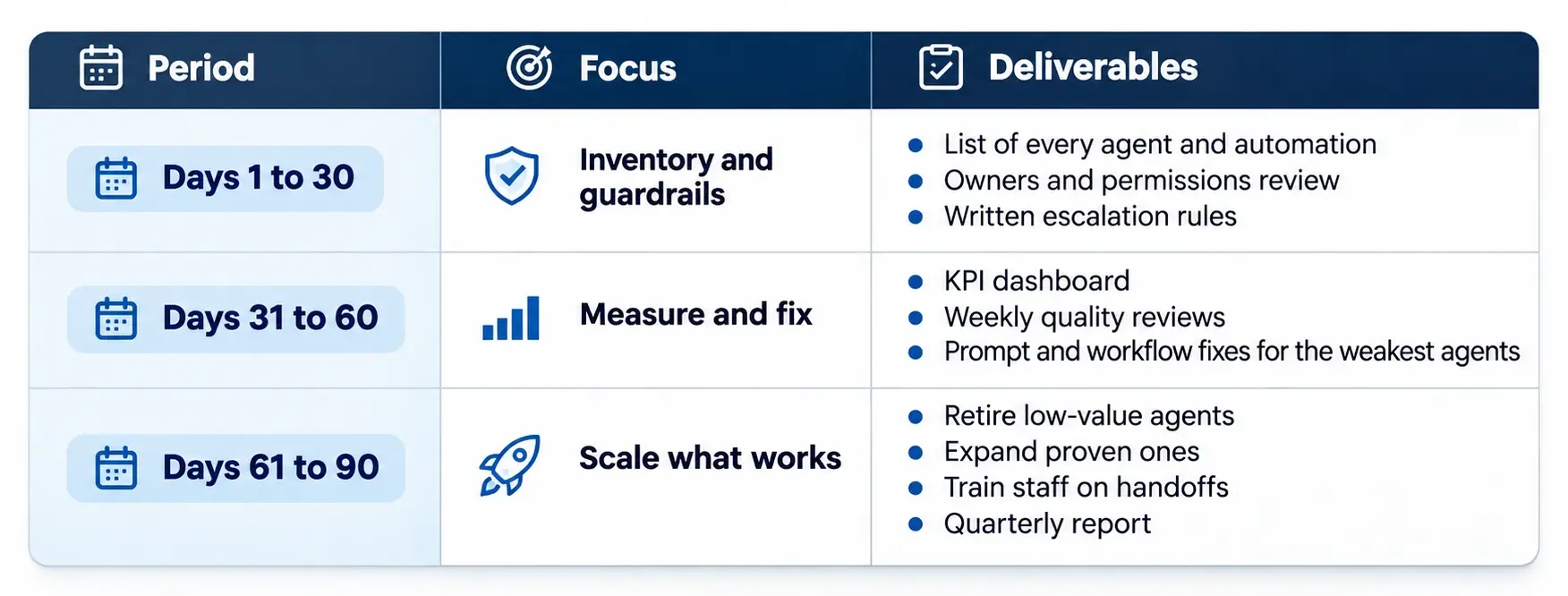
A new agent manager should follow a clear sequence. First control the risks, then fix performance, then scale what works.
Most agent failures come from how agents are managed, not from the technology. Avoid these five mistakes.
AI agents can save hours every week, but only when someone owns their results. Without that owner, they drift, make errors and lose your team's trust.
An AI agent manager sets the guardrails, tracks the numbers and keeps improving every agent. You do not need an executive hire to fill this role. AI Virtual can place a pre-vetted AI specialist as your dedicated agent manager, starting at [from $19/hour].
An AI agent manager is the person accountable for how AI agents perform in a business. They assign tasks to agents, set permissions and escalation rules, monitor accuracy and cost, improve prompts and workflows, and coordinate handoffs with human staff.
Typical daily work includes reviewing samples of agent output, checking dashboards for errors and escalations, updating instructions or knowledge sources, handling exceptions the agents flag, and answering staff questions about how agents work.
Partly. The role needs comfort with prompts, permissions and dashboards, but strong process thinking, quality review and knowledge of the business matter as much as coding skills.
An AI engineer builds and deploys AI systems. An AI agent manager makes sure deployed agents do the right work, follow the rules and deliver measurable business results.
Yes, once an agent can contact clients, change records or handle money without approval of every action. Small firms usually assign the role to a dedicated AI specialist rather than creating a senior position.
Harvard Business Review published "To Thrive in the AI Era, Companies Need Agent Managers" by Suraj Srinivasan and Vivienne Wei in February 2026, comparing the role to the product manager. Microsoft's 2025 Work Trend Index also described employees becoming "agent bosses."
Get matched with an AI specialist who identifies opportunities and implements solutions that improve your operations.
We're working on new guides for this topic. Check back soon, or browse all posts to see everything we've published.